.
As fellow blogger Baydog so nobly explains in his post today, Tillerman is off across the sea to do battle in the Laser Masters World Slamdown, held this year in crusty olde England.
Tillerman has before him an ordeal of the most grievous kind. He has before him many, many long days of struggle and of suffering. You ask, what is his policy? I can say it is to wage war by sea, with all his might and with all the strength that god can give him; to wage war against a monstrous tyranny, never surpassed in the dark, lamentable catalogue of Laser sailing. That is his policy.
You ask, what is his aim? I can answer in one word: It is victory, victory at all costs, victory in spite of all terror, victory, however long and hard the road may be; for without victory, there is no gloating. Let that be realized; no gloating for Tillerman, no survival for all that Tillerman has stood for, no survival for the urge and impulse of the ages, that his blog will move forward towards its goal of world domination.
Tillerman has trained long and hard in preparation for this moment. He has practiced in his little boat, in his little bay, till his abs ache from hiking. He has sailed in local regattas and met the competition with vigor and resolve. He has run the streets and hills and beaches and hedgerows of Tiverton till his tennies are torn and tattered.
And this is not the end of his ordeal. It is not even the beginning of the end. But it is, perhaps, the end of the beginning.
He takes up his task with buoyancy and hope. I feel sure that his cause will not be suffered to fail among men, though he has nothing to offer but blood, toil, tears, and sweaty hiking pants.
.

September 7, 2010

September 1, 2010

August 25, 2010
Ten Reasons
.
The things I don't do for Tillerman.
Yesterday, I left an innocent comment on his blog, praising the lovely sailing conditions we enjoy on San Francisco Bay, whereupon he challenged me to give him reasons that he should sail here. There's some sort of Laser race for geriatrics being held here next year, and he has been making noises about coming out to participate.
Here is the Tillerman-tossed gauntlet:
So, here I am writing a blog post to make him happy. And a post composed of a list, no less.
I normally don't do 'List' blog posts, mainly because that is a mechanical device for cranking out a post and I'm a less structured, more freeform kind of guy. But I think the idea to create a 'List' post was itself on one of those lists about how to write a successful blog - something like "Twelve Things You Must Do To Write A Successful Blog Because Eleven Things Wouldn't Be Enough". One of those twelve things was Make A Blog Post Out Of A List. And since Tillerman is a rather, well, structured kind of guy, he likes lists.
Some people are insecure in their natural ability to know when a task is complete and feel that the artificial device of having a list and checking off its items will insure success. We all have our little crutches to get through life. Tillerman's seems to be making lists.
Mine is beer.
So, in an effort to placate He Who Must Be Obeyed and to convince him to come sailing in San Francisco next summer, here is my list of Ten Reasons To Sail In San Francisco.
1) Our Frigging Flowers. You didn't think I was going to let that little remark about flowers go unchallenged, did you? Tillerman is a very focused kind of sailor. When he gets on that Laser, he is very dialed in. It's all concentration about technique, about strategy, about timing the perfect start, finding the perfect lane, knowing the unknowable about which side is favored. I think that's why he doesn't win more often. He's too damn focused. His hiking pants are all in a knot. San Francisco sailors are much more laid back. We take time to smell our flowers, to consider sailing as part of a balanced life that includes many elements, even the flowers. We are more relaxed and philosophical, and I think staying loose and being free to adjust to changing conditions can only be an advantage on the race course. Tillerman, come to San Francisco and learn how to relax a little.
2) Our wind. No, it doesn't blow a steady 18 knots every day of the year, but looking back over any sailing season, it sure seems that way. Because of peculiarities of our local topography and how that affects wind currents, we enjoy what is one of the most reliable and predictable wind machines on the planet. Don't take my word for it, or the word of about a bazillion people who know more about sailing than I do. Try it. You'll like it.
3) Our currents. Like a good game of chess? Don't like a race course that's the same every week? Come to San Francisco! If you've mastered sail trim, timing the perfect start, reading the wind, surfing the waves, and all of that other stuff that sailors need to know about, no matter where they sail, you will still end up at the back of the pack here if you don't know how our currents work. The cool thing is that no one knows for sure how they work, no matter how long they've been sailing here. Our currents are that diabolical. In most other sailing venues, you can find out what you need to know from a simple tide chart. Ha! Ha! Ha! Ha! Ha! The overall winner of last year's Three Bridge Fiasco, who has been sailing the bay for at least 200 years, went out on the course the day before the race and spent all day sailing to key spots at about the times he thought he would be getting there in the race - just to see what our frigging currents were up to. Did I mention that he was first out of 300 boats?
4) Larry Ellison lives here. Tillerman, the guy bought a little fixer-upper cottage on the ocean in Newport last year, just down the road from you. He's a neighbor, right? Surely he'd be happy to see you and to take you out for a sail. I think he has more than one boat. And even if he asks you on a light air day, he has one very fast trimaran that he only takes out on light air days.
5) You can walk, jog, or bike across the Golden Gate Bridge. All sailing and no play makes Tillerman a dull boy. It's great enough that we have the most photographed bridge in the world available anytime for photo ops, but even though it was built in 1936, they still had the foresight to put a walkway on it. I don't care how much of a jaded East Coast type you are, this is still very cool.
6) There are more great restaurants in the Bay per square centimeter than anywhere else on the planet. OK, this may be a tough one to support with hard data, but I think there are definitely more restaurants here than in all of Rhode Island, if you don't count greasy chicken joints.
7) This is a much better time zone than Rhode Island's. When you're going to bed in Rhode Island, we still have another three hours to party. Heck, when Tillerman's going to bed, we probably still have another five hours to party.
8) Two words - No Frostbiting
9) San Francisco - not London, not Portsmouth, not Fowey, not Grumbleywicket on Tyne, not even frigging Dublin - was the birthplace of Irish Coffee.
10) Now that I've dispensed with the tedious device of compiling a list, may I make a plea for what is really the reason that you should come to San Francisco?
Have you ever awakened earlier than usual on a crisp, fall morning, when things were yet clear and still, and felt a sense of both inner peace and energetic anticipation to get on with the events of the day?
Have you ever felt, at the end of a long run, a sudden pulse of energy that you weren't expecting, that gave a certain lightness to your step and drove you to the finish in a rush that made you forget all fatigue?
Have you ever been stopped in your tracks, shaken from a tedious routine or from a frenetic dash to get somewhere you didn't really need to be rushing to by a single sound - a child's laugh, the cry of a gull, that made you realize there might be more in that laugh or cry than in the busy entirety of the rest of your day?
Have you ever watched the sun drop stoically into the sea at the end of a long day of work, more tired than you ever thought you could be, only to discover it was a good kind of weariness for what you had accomplished that day?
If you've felt any of these things, then you know a tenth of the joy and anticipation and fulfillment we have whenever we push our boats out from the harbors, out from the marinas, out from the launch ramps, out from the backwaters of San Francisco into these tender and terrifying waters that we so proudly call home.
.
The things I don't do for Tillerman.
Yesterday, I left an innocent comment on his blog, praising the lovely sailing conditions we enjoy on San Francisco Bay, whereupon he challenged me to give him reasons that he should sail here. There's some sort of Laser race for geriatrics being held here next year, and he has been making noises about coming out to participate.
Here is the Tillerman-tossed gauntlet:
Please give me Ten Reasons to Sail in San Francisco Next Summer. I'm willing to be convinced. You could even make it a blog post (unless you are planning to write more posts about frigging flowers.)
So, here I am writing a blog post to make him happy. And a post composed of a list, no less.
I normally don't do 'List' blog posts, mainly because that is a mechanical device for cranking out a post and I'm a less structured, more freeform kind of guy. But I think the idea to create a 'List' post was itself on one of those lists about how to write a successful blog - something like "Twelve Things You Must Do To Write A Successful Blog Because Eleven Things Wouldn't Be Enough". One of those twelve things was Make A Blog Post Out Of A List. And since Tillerman is a rather, well, structured kind of guy, he likes lists.
Some people are insecure in their natural ability to know when a task is complete and feel that the artificial device of having a list and checking off its items will insure success. We all have our little crutches to get through life. Tillerman's seems to be making lists.
Mine is beer.
So, in an effort to placate He Who Must Be Obeyed and to convince him to come sailing in San Francisco next summer, here is my list of Ten Reasons To Sail In San Francisco.
1) Our Frigging Flowers. You didn't think I was going to let that little remark about flowers go unchallenged, did you? Tillerman is a very focused kind of sailor. When he gets on that Laser, he is very dialed in. It's all concentration about technique, about strategy, about timing the perfect start, finding the perfect lane, knowing the unknowable about which side is favored. I think that's why he doesn't win more often. He's too damn focused. His hiking pants are all in a knot. San Francisco sailors are much more laid back. We take time to smell our flowers, to consider sailing as part of a balanced life that includes many elements, even the flowers. We are more relaxed and philosophical, and I think staying loose and being free to adjust to changing conditions can only be an advantage on the race course. Tillerman, come to San Francisco and learn how to relax a little.
2) Our wind. No, it doesn't blow a steady 18 knots every day of the year, but looking back over any sailing season, it sure seems that way. Because of peculiarities of our local topography and how that affects wind currents, we enjoy what is one of the most reliable and predictable wind machines on the planet. Don't take my word for it, or the word of about a bazillion people who know more about sailing than I do. Try it. You'll like it.
3) Our currents. Like a good game of chess? Don't like a race course that's the same every week? Come to San Francisco! If you've mastered sail trim, timing the perfect start, reading the wind, surfing the waves, and all of that other stuff that sailors need to know about, no matter where they sail, you will still end up at the back of the pack here if you don't know how our currents work. The cool thing is that no one knows for sure how they work, no matter how long they've been sailing here. Our currents are that diabolical. In most other sailing venues, you can find out what you need to know from a simple tide chart. Ha! Ha! Ha! Ha! Ha! The overall winner of last year's Three Bridge Fiasco, who has been sailing the bay for at least 200 years, went out on the course the day before the race and spent all day sailing to key spots at about the times he thought he would be getting there in the race - just to see what our frigging currents were up to. Did I mention that he was first out of 300 boats?
4) Larry Ellison lives here. Tillerman, the guy bought a little fixer-upper cottage on the ocean in Newport last year, just down the road from you. He's a neighbor, right? Surely he'd be happy to see you and to take you out for a sail. I think he has more than one boat. And even if he asks you on a light air day, he has one very fast trimaran that he only takes out on light air days.
5) You can walk, jog, or bike across the Golden Gate Bridge. All sailing and no play makes Tillerman a dull boy. It's great enough that we have the most photographed bridge in the world available anytime for photo ops, but even though it was built in 1936, they still had the foresight to put a walkway on it. I don't care how much of a jaded East Coast type you are, this is still very cool.
6) There are more great restaurants in the Bay per square centimeter than anywhere else on the planet. OK, this may be a tough one to support with hard data, but I think there are definitely more restaurants here than in all of Rhode Island, if you don't count greasy chicken joints.
7) This is a much better time zone than Rhode Island's. When you're going to bed in Rhode Island, we still have another three hours to party. Heck, when Tillerman's going to bed, we probably still have another five hours to party.
8) Two words - No Frostbiting
9) San Francisco - not London, not Portsmouth, not Fowey, not Grumbleywicket on Tyne, not even frigging Dublin - was the birthplace of Irish Coffee.
10) Now that I've dispensed with the tedious device of compiling a list, may I make a plea for what is really the reason that you should come to San Francisco?
Have you ever awakened earlier than usual on a crisp, fall morning, when things were yet clear and still, and felt a sense of both inner peace and energetic anticipation to get on with the events of the day?
Have you ever felt, at the end of a long run, a sudden pulse of energy that you weren't expecting, that gave a certain lightness to your step and drove you to the finish in a rush that made you forget all fatigue?
Have you ever been stopped in your tracks, shaken from a tedious routine or from a frenetic dash to get somewhere you didn't really need to be rushing to by a single sound - a child's laugh, the cry of a gull, that made you realize there might be more in that laugh or cry than in the busy entirety of the rest of your day?
Have you ever watched the sun drop stoically into the sea at the end of a long day of work, more tired than you ever thought you could be, only to discover it was a good kind of weariness for what you had accomplished that day?
If you've felt any of these things, then you know a tenth of the joy and anticipation and fulfillment we have whenever we push our boats out from the harbors, out from the marinas, out from the launch ramps, out from the backwaters of San Francisco into these tender and terrifying waters that we so proudly call home.
.
August 23, 2010
The Big O
.
Hawaiian native and prisoner of New York City, Frogma, has posted pix of some of her fellow Hawaiian natives. These natives are not the high school classmates that Frogma went back to visit recently, but natives of the beaches, meadows, and forests of Hawaii. They are the flowers that are indigenous to the islands.
As botany is not one of my strengths, I didn't recognize most of the flowers until I came to one that every Californian knows - the Oleander.

Talk about an immigrant success story!
Oleanders must be happier, more established, and better known in California than they are anywhere else - even Hawaii. They moved here many years ago, put down roots, and set about populating the state, literally from one end to the other.
They didn't do this on their own, though. They had help.
Their tenacious hardiness soon impressed many Californians, but most notably they impressed Caltrans - the bureaucracy of highway, biway, and bridge builders that is the de facto governing body of California.
Your state may have a highway department, but it is nothing like Caltrans.
Caltrans has an annual budget that surpasses the GDP of most third world countries.
Governators may govern, legislators and judges may serve their terms, lobbyists may lobby, lawyers litigate, and councils counsel, but, they are all mortal. In time, they all fade away, are indicted, or retire to the White House.
But Caltrans is forever.
Eternal. Immutable. Sacred.
In a state whose culture and economy revolve around the car more than anywhere else, Caltrans is the rock (and gravel and concrete) upon which Californians depend.
And if Caltrans embraces you, champions you, advances your star, you too shall become eternal, immutable, and sacred.
And so it has been with the Oleander. India has the cow, California the Oleander.
Caltrans has planted vast, endless colonnades of Oleander that parade for hundreds of miles down the medians of our freeways, the Niles of our commerce.

Because as it turns out, Oleanders are the perfect vehicle for shepherding vehicles.
They are tough, robust, require almost no water, and grow quicker than rumor. At night, they block the glaring headlights of oncoming traffic. A stand of Oleander can absorb a wayward pickup truck that hurtles into the median at 80 miles an hour, wrestle the truck to the ground, and recover within a year or so with no human intervention. Guardrails and concrete barriers are much more expensive to plant, seldom flower, and are not nearly so adept at healing themselves.
The only thing about Oleanders that puzzles me is the fuss people make about them being poisonous. I mean, it's not as if Oleanders sneak up and bite you. For Oleanders to be poisonous, you have to eat them.
And who goes around eating shrubbery?
People make such a big deal about this. Whenever the conversation drifts to Oleanders (I know, I'm going to the wrong parties), the first thing everyone says is, "But you know, they're poisonous."
Just like your mom used to warn you about poking your eye out.
I think this may actually be one of those urban myths, though. I scoured Google looking for examples of people who had actually died from eating Oleander. Almost every reference comes back to the same anonymous group of 'some kids' who roasted marshmallows at a cookout on Oleander sticks and who all died. Nowhere are those kids or their scout troup or their Kiwanis club identified. I think this is just another case of you'll poke your eye out.
The other alleged example of Oleander poisoning refers to a bunch of off-duty marines who were so drunk they stopped on a freeway median one night to have a cookout and, again, did the marshmallow en brochette thing, using Oleanders for the brochettes. These guys apparently didn't die but got very sick. This story also sounds bogus to me, because if those marines were drunk enough to be cooking out in the middle of a freeway, their morning-after malaise had nothing to do with Oleander. Trust me on this, but don't ask how I know.
I know this is a sailing blog and that Oleanders have nothing to do with sailing. But, don't blame me.
Frogma started it.
.
Hawaiian native and prisoner of New York City, Frogma, has posted pix of some of her fellow Hawaiian natives. These natives are not the high school classmates that Frogma went back to visit recently, but natives of the beaches, meadows, and forests of Hawaii. They are the flowers that are indigenous to the islands.
As botany is not one of my strengths, I didn't recognize most of the flowers until I came to one that every Californian knows - the Oleander.

Photo by Phrogma
Talk about an immigrant success story!
Oleanders must be happier, more established, and better known in California than they are anywhere else - even Hawaii. They moved here many years ago, put down roots, and set about populating the state, literally from one end to the other.
They didn't do this on their own, though. They had help.
Their tenacious hardiness soon impressed many Californians, but most notably they impressed Caltrans - the bureaucracy of highway, biway, and bridge builders that is the de facto governing body of California.
Your state may have a highway department, but it is nothing like Caltrans.
Caltrans has an annual budget that surpasses the GDP of most third world countries.
Governators may govern, legislators and judges may serve their terms, lobbyists may lobby, lawyers litigate, and councils counsel, but, they are all mortal. In time, they all fade away, are indicted, or retire to the White House.
But Caltrans is forever.
Eternal. Immutable. Sacred.
In a state whose culture and economy revolve around the car more than anywhere else, Caltrans is the rock (and gravel and concrete) upon which Californians depend.
And if Caltrans embraces you, champions you, advances your star, you too shall become eternal, immutable, and sacred.
And so it has been with the Oleander. India has the cow, California the Oleander.
Caltrans has planted vast, endless colonnades of Oleander that parade for hundreds of miles down the medians of our freeways, the Niles of our commerce.

Oleanders By The Overpass, Alas
Because as it turns out, Oleanders are the perfect vehicle for shepherding vehicles.
They are tough, robust, require almost no water, and grow quicker than rumor. At night, they block the glaring headlights of oncoming traffic. A stand of Oleander can absorb a wayward pickup truck that hurtles into the median at 80 miles an hour, wrestle the truck to the ground, and recover within a year or so with no human intervention. Guardrails and concrete barriers are much more expensive to plant, seldom flower, and are not nearly so adept at healing themselves.
The only thing about Oleanders that puzzles me is the fuss people make about them being poisonous. I mean, it's not as if Oleanders sneak up and bite you. For Oleanders to be poisonous, you have to eat them.
And who goes around eating shrubbery?
People make such a big deal about this. Whenever the conversation drifts to Oleanders (I know, I'm going to the wrong parties), the first thing everyone says is, "But you know, they're poisonous."
Just like your mom used to warn you about poking your eye out.
I think this may actually be one of those urban myths, though. I scoured Google looking for examples of people who had actually died from eating Oleander. Almost every reference comes back to the same anonymous group of 'some kids' who roasted marshmallows at a cookout on Oleander sticks and who all died. Nowhere are those kids or their scout troup or their Kiwanis club identified. I think this is just another case of you'll poke your eye out.
The other alleged example of Oleander poisoning refers to a bunch of off-duty marines who were so drunk they stopped on a freeway median one night to have a cookout and, again, did the marshmallow en brochette thing, using Oleanders for the brochettes. These guys apparently didn't die but got very sick. This story also sounds bogus to me, because if those marines were drunk enough to be cooking out in the middle of a freeway, their morning-after malaise had nothing to do with Oleander. Trust me on this, but don't ask how I know.
I know this is a sailing blog and that Oleanders have nothing to do with sailing. But, don't blame me.
Frogma started it.
.
August 8, 2010
Our Huddled Masses
.
Sociologists tell us the human animal needs its space.
Even if we have no cat, we need the room to swing one.
We may be communal by nature, but we've got to have our breathing room. We can take our fellow humans in close quarters, but only so close.
So how close is too close? What is 'cheek by jowl' and what is just cheeky? That seems to vary from culture to culture and from place to place. What's comfy in Kowloon, is in your face in Fargo.
California is one of those places where we seem to bunch up with our fellow humans. We tend to tolerate each other's jowls here. There's only so much sunshine and everyone wants to be in it.
You see this bunching up in almost everything Californians do.
We live in boxes, little boxes, and they're all made out of ticky tacky and they all look just the same:

We work in cubes, little cubes, and THEY all look the same:

We drive from those boxes to those cubes, lined up like lemmings in lots of loathsome lanes:

Even when we go to the beach, we do it all bunched up:



Sociologists tell us the human animal needs its space.
Even if we have no cat, we need the room to swing one.
We may be communal by nature, but we've got to have our breathing room. We can take our fellow humans in close quarters, but only so close.
So how close is too close? What is 'cheek by jowl' and what is just cheeky? That seems to vary from culture to culture and from place to place. What's comfy in Kowloon, is in your face in Fargo.
California is one of those places where we seem to bunch up with our fellow humans. We tend to tolerate each other's jowls here. There's only so much sunshine and everyone wants to be in it.
You see this bunching up in almost everything Californians do.
We live in boxes, little boxes, and they're all made out of ticky tacky and they all look just the same:

We work in cubes, little cubes, and THEY all look the same:

We drive from those boxes to those cubes, lined up like lemmings in lots of loathsome lanes:

Even when we go to the beach, we do it all bunched up:

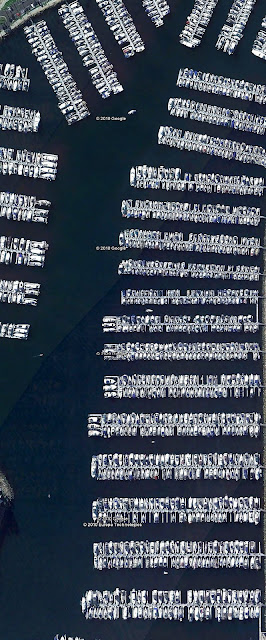
And we park our boats that way, too:

So, I guess I shouldn't have been surprised, while walking across my favorite bridge over the American River last weekend, to look down into those serene waters and see this:

which was part of this:

which was only a small part of all of this:

Just a bunch of my fellow Californians getting away from it all for a nice, quiet weekend on the water.
Away from those crowded cul-de-sacs. Away from those crowded cubicles. Away from those crowded freeways.
But doing it in the way they've grown accustomed to.
All bunched up.
.
August 2, 2010
Of Big Boats And Little Boats
.


I've looked at boats from both sides now, from big and small, and still, somehow ...wait, who's writing this post - me or Joni Mitchell?
Well, still, somehow, I can't make up my mind which I like better - the bigger boat or the little boat.
I'm kind of resigned to the bigger boat with its comfy space to sleep down below. Until they extend the ocean to Sacramento, we have a 90-mile drive before we can go sailing. Once we've driven to Berkeley, we usually like staying there for a few days. And it's nice to be able to crash on the boat after a sail without having to worry about a long drive home.
Purely by accident, I have also discovered that, with a boat big enough to sleep on, I can drink distilled and fermented spirits after sailing without endangering my fellow motorists, so the bigger boat performs a sort of public service, too.
But I had a chance to sail a small boat again a few weeks ago, and rediscovered some of the small boat's virtues. They are many.
I've posted before about how my wife has just taken a basic keelboat class. To make best use of the instructor's time, they cram a whole lotta stuff into a three-day class. They really expect students to do most of their learning in the practice sessions after the class. So, I've been going out with my wife in the training boats - Capri 22's.

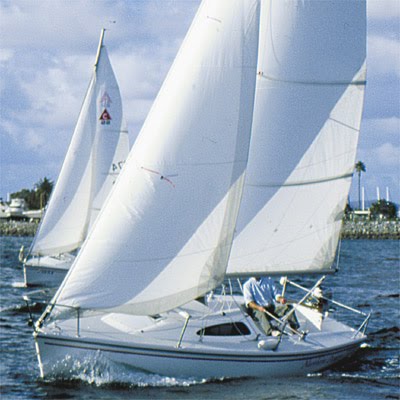
These boats may seem big to a Laser sailor, but they still handle like dinghies. They move OK in just a few knots of breeze, respond pretty quick to a puff, and can be short-tacked through a very narrow channel. But, most importantly, they still give that direct, seat-of-the-pants feedback to the wind and to the helm that is so important when you're learning how a sailboat works. Unlike a Laser, though, they won't leave you swimming if you muck up a jibe. They're great boats for learning the basics of tiller and sheet.
It's too bad those basics seem to be almost left out of the ASA basic keelboat class.
Huh? Isn't that what a beginning sailing class is supossed to teach?
Well, I've just sat in on my wife's class, and, with all of the jargon and tacking drills and docking practice and man overboard drills and how to use a roller furler and how to read a tide chart and how to fill out the boat checkout forms, they somehow never got to the part where I think most people actually learn how to sail.
And that's the part where you just play with the boat - you know, the fun part.
My wife passed the class with flying colors, but seemed overwhelmed by all the stuff she had to memorize. Is learning to sail really about memorizing stuff? I think it's about picking up that instinctive feeling - somewhere between your navel and your noodle - for what to do when the wind fills a sail.
It's something like the knack of riding a bicycle, but not quite. The bike always goes whenever you push the pedals, no matter what the wind is doing. To sail, you've got to get your head out of the boat and feel what the wind is doing. And you can't really see the wind. There's no red line drawn on the water - like in the textbooks - to show you which way it's blowing.
See how I'm burning up a lot of words here to explain something you just have to feel? That's kinda what the guys who wrote my wife's sailing textbook did. I'm not sure there's any other way to do it when you have to write down and formalize this stuff.
So, a few weeks ago, we went out in the little boat to see what we could feel. No drills, no beam reaches, no 45-degree angles to the wind. Just turn until the boat starts going and then turn the other way until it slows down. Pull the sheet in until we find the groove, then ease off until we lose it. We kept the jib furled the whole day.
One sail, one tiller, one sheet.
My wife started feeling better about the boat right away.
One sail, one tiller, one sheet.
My wife started feeling better about the boat right away.
She started feeling better about the dumb motor, too. That's because we left it turned off. In the three-day class, they had never once shown how easy it is to sail a small boat up to a dock. We tried that a few times and she was no longer worried about what would happen if we couldn't get the balky outboard to start.
For my wife and me there will be more days of feeling things in the little boat.
I think that's really what little boats are all about.
July 29, 2010
More Dark
.
After goofing off for two weeks, I had finally written a post for today, but then I read Edward's great story about a night watch during the recent Pacific Cup. It was on a night that was darker than the inside of Johnny Cash's wardrobe trunk.
After reading Edward's post, I decided to declare this Dark Week in the blogosphere.

Edward's story struck a nerve, or rang a bell, or did whatever stories do when you hear one and think, "Oh wow, I know that feeling."
I, too, had a memorable few hours of hoary darkness on my boat one dark and not-so-stormy night. It wasn't in any big-time sailboat race. It wasn't a zillion miles from nowhere. There were no giant swells swelling, or awful winds blowing, or icy spray spraying.
But cripes, was it dark.
Dark in a way you can't believe until you look behind you and discover there is no behind you.
We were working our way down the coast to Monterey last summer, harbor hopping one day of sailing at a time.
Our long hop was from Half Moon Bay to Santa Cruz - about 50 miles - and to promote domestic tranquility I thought it wise to make sure we got into Santa Cruz before the shades of night were falling. I figured a few hours of night sailing would be better at the start of our day than at the end, so we left HMB at 4:30 am.
The thing about Half Moon Bay that is most consistent is the fog. When it is clear up and down the coast, it can and probably will be foggy in Half Moon Bay. Day or night, rain or shine, summer or winter. And that morning, foggy it was.
We made it to the outer breakwater within sight of a few shore lights which painted fuzzy cotton candy circles of yellow in the fog and, while I didn't quite realize it yet, those fuzzy circles also lent a sense of up and down and left and right. Oh alright, port and starboard. I was relying on the GPS to find our way through the gap in the breakwater, then around the scary reef, and through the entrance buoys about a mile away.
About 100 yards outside the breakwater, a very spooky feeling settled in. Someone had turned out the lights. All of them. There is nothing darker than being in a thick fog on a moonless night. And unlike Edward's raucous swells and wind and spray, this night was still. Very, very still.
We were motoring out into the murk. Except it was too dark to see if it was actually murky. This must be what one of those sensory deprivation chambers is like. No up, no down, no forward, no aft, no left or right. Oh alright, dammit, no port or starboard.
There was almost no sense of motion at all. I was in a little world of just me and the GPS.
And then, it was just me.
The unthinkable had been thought. Like everything else around me, the GPS went dark.
After a few moments of thinking that divorce court might not be so bad, I realized the GPS must still be working. It was just the backlight that had shut off after a preset time delay. All I had to do was work my way through 16 menus to find the one that would keep the little backlight on.
While keeping the boat off the scary little reef that was somewhere very close by.
Which I had no way of doing without seeing the screen on the GPS. Hmmm.
I decided to keep pushing the little backlight button every minute until we cleared the reef and made it out past the entrance buoys. Then, I could deal with the 16 menus without fear of munching the hull. Although, at this point, divorce court was still a definite possibility.
The next fifteen minutes flashed by in what seemed like merely hours, but finally we were past the reef, out in deep water, and I could find the damned backlight menu on the GPS.
To make things easier (I thought), I got us pointed to our next waypoint and flipped on my trusty autopilot (familiar to regular readers of this blog) to hold that course. I set to work fumbling through the 16 menus, everything taking a whole lot longer than it does when you do this stuff on your dining room table.
Finally, there it was, 'Backlight Timeout - None'. Click 'OK'.
What the freak do you mean 'Am I sure?'.
With one last click, the backlight was on and the GPS was back to the main display. But I couldn't believe what I was seeing.
We were humming smoothly along, but the GPS had now gone beserk. The happy little arrow that always points calmly to our next waypoint was now doing complete circles all the way around the dial. Our course was now North West South East North West South East North West South...
This couldn't be happening. The next thing I expected to hear was Rod Serling doing a voiceover.
Or maybe Alfred Hitchcock would peer up out of the companionway. If I could see the companionway.
I froze for a moment and then thought of what a pilot friend had told me about learning to fly by instruments. Forget about your instincts and believe the instruments. In zero visibility, your instincts are almost always wrong.
I switched off the autopilot and started turning the wheel in the direction that would have slowed the wild spinning of the GPS. The spinning needle started to slow.
More steering and it slowed some more. Finally, I got the needle to stop and gradually was able to steer us back on course. It was then I realized the autopilot had slipped out, the wheel had gone hard over, and just as the GPS had been telling me, we were turning in tight little circles - round and round and round.
The really bizarre thing was that, without any visual references, out there in the Pacific Ocean sensory deprivation chamber, there was absolutley no sense of turning at all. It's something you just have to experience to believe.
We motored on in silence for a while. I realized I could buy my wife a nice dinner once we got to Santa Cruz, as I wouldn't need to hire a divorce attorney, after all.
I had learned a few more lessons about GPS and about autopilots and about boats and about voyaging.
And about the dark.
.
After goofing off for two weeks, I had finally written a post for today, but then I read Edward's great story about a night watch during the recent Pacific Cup. It was on a night that was darker than the inside of Johnny Cash's wardrobe trunk.
After reading Edward's post, I decided to declare this Dark Week in the blogosphere.

Photo of The Dark courtesy of EVK4
Edward's story struck a nerve, or rang a bell, or did whatever stories do when you hear one and think, "Oh wow, I know that feeling."
I, too, had a memorable few hours of hoary darkness on my boat one dark and not-so-stormy night. It wasn't in any big-time sailboat race. It wasn't a zillion miles from nowhere. There were no giant swells swelling, or awful winds blowing, or icy spray spraying.
But cripes, was it dark.
Dark in a way you can't believe until you look behind you and discover there is no behind you.
We were working our way down the coast to Monterey last summer, harbor hopping one day of sailing at a time.
Our long hop was from Half Moon Bay to Santa Cruz - about 50 miles - and to promote domestic tranquility I thought it wise to make sure we got into Santa Cruz before the shades of night were falling. I figured a few hours of night sailing would be better at the start of our day than at the end, so we left HMB at 4:30 am.
The thing about Half Moon Bay that is most consistent is the fog. When it is clear up and down the coast, it can and probably will be foggy in Half Moon Bay. Day or night, rain or shine, summer or winter. And that morning, foggy it was.
We made it to the outer breakwater within sight of a few shore lights which painted fuzzy cotton candy circles of yellow in the fog and, while I didn't quite realize it yet, those fuzzy circles also lent a sense of up and down and left and right. Oh alright, port and starboard. I was relying on the GPS to find our way through the gap in the breakwater, then around the scary reef, and through the entrance buoys about a mile away.
About 100 yards outside the breakwater, a very spooky feeling settled in. Someone had turned out the lights. All of them. There is nothing darker than being in a thick fog on a moonless night. And unlike Edward's raucous swells and wind and spray, this night was still. Very, very still.
We were motoring out into the murk. Except it was too dark to see if it was actually murky. This must be what one of those sensory deprivation chambers is like. No up, no down, no forward, no aft, no left or right. Oh alright, dammit, no port or starboard.
There was almost no sense of motion at all. I was in a little world of just me and the GPS.
And then, it was just me.
The unthinkable had been thought. Like everything else around me, the GPS went dark.
After a few moments of thinking that divorce court might not be so bad, I realized the GPS must still be working. It was just the backlight that had shut off after a preset time delay. All I had to do was work my way through 16 menus to find the one that would keep the little backlight on.
While keeping the boat off the scary little reef that was somewhere very close by.
Which I had no way of doing without seeing the screen on the GPS. Hmmm.
I decided to keep pushing the little backlight button every minute until we cleared the reef and made it out past the entrance buoys. Then, I could deal with the 16 menus without fear of munching the hull. Although, at this point, divorce court was still a definite possibility.
The next fifteen minutes flashed by in what seemed like merely hours, but finally we were past the reef, out in deep water, and I could find the damned backlight menu on the GPS.
To make things easier (I thought), I got us pointed to our next waypoint and flipped on my trusty autopilot (familiar to regular readers of this blog) to hold that course. I set to work fumbling through the 16 menus, everything taking a whole lot longer than it does when you do this stuff on your dining room table.
Finally, there it was, 'Backlight Timeout - None'. Click 'OK'.
What the freak do you mean 'Am I sure?'.
With one last click, the backlight was on and the GPS was back to the main display. But I couldn't believe what I was seeing.
We were humming smoothly along, but the GPS had now gone beserk. The happy little arrow that always points calmly to our next waypoint was now doing complete circles all the way around the dial. Our course was now North West South East North West South East North West South...
This couldn't be happening. The next thing I expected to hear was Rod Serling doing a voiceover.
Or maybe Alfred Hitchcock would peer up out of the companionway. If I could see the companionway.
I froze for a moment and then thought of what a pilot friend had told me about learning to fly by instruments. Forget about your instincts and believe the instruments. In zero visibility, your instincts are almost always wrong.
I switched off the autopilot and started turning the wheel in the direction that would have slowed the wild spinning of the GPS. The spinning needle started to slow.
More steering and it slowed some more. Finally, I got the needle to stop and gradually was able to steer us back on course. It was then I realized the autopilot had slipped out, the wheel had gone hard over, and just as the GPS had been telling me, we were turning in tight little circles - round and round and round.
The really bizarre thing was that, without any visual references, out there in the Pacific Ocean sensory deprivation chamber, there was absolutley no sense of turning at all. It's something you just have to experience to believe.
We motored on in silence for a while. I realized I could buy my wife a nice dinner once we got to Santa Cruz, as I wouldn't need to hire a divorce attorney, after all.
I had learned a few more lessons about GPS and about autopilots and about boats and about voyaging.
And about the dark.
.
Subscribe to:
Posts (Atom)